Usage-Based Car Insurance & Telematics: How Much Can You Save?
Traditional auto insurance pricing relies heavily on demographic statistics. Insurers evaluate factors like your age, credit score, ZIP code, and gender to estimate your collision risk. Consequently, safe drivers frequently subsidize the costs of reckless motorists in the same demographic pool. Fortunately, modern telematics technology offers a fairer alternative.
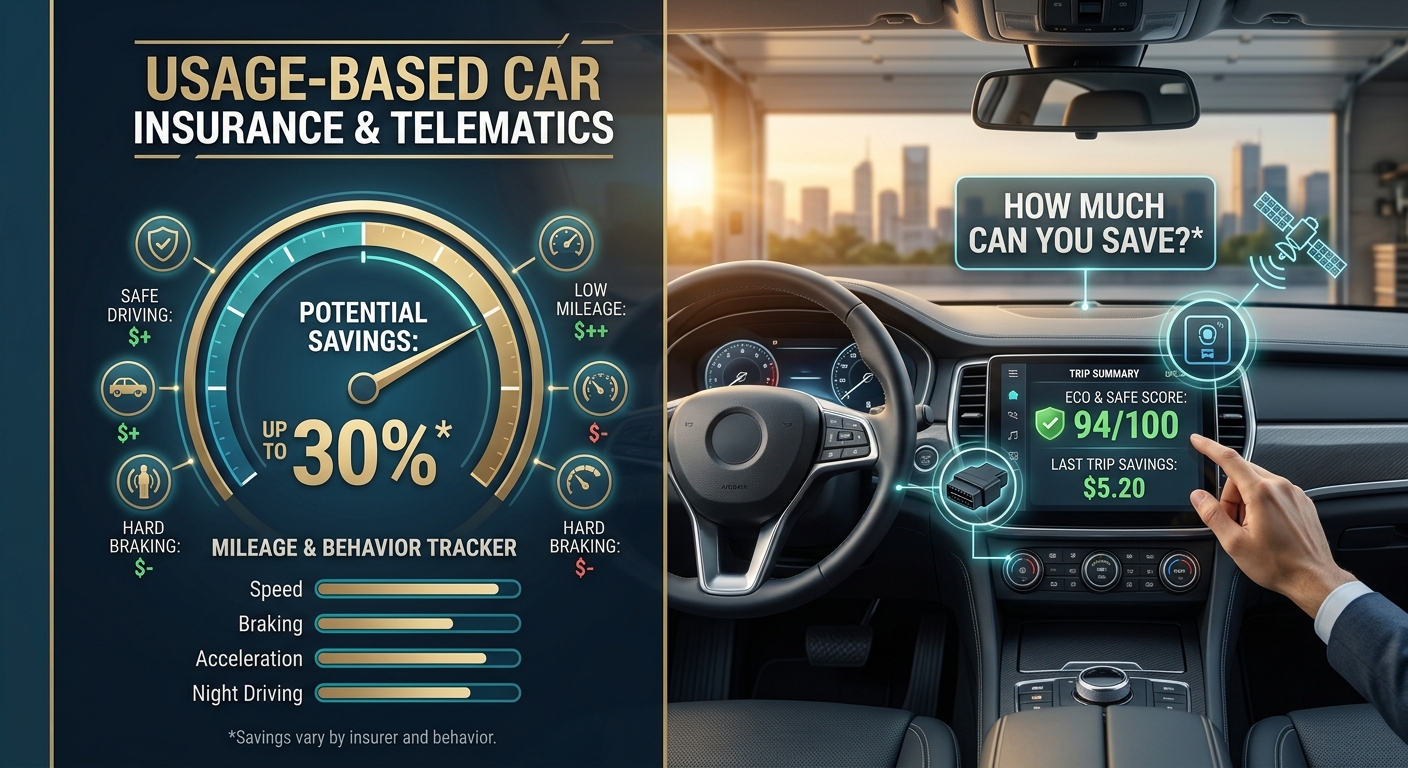
By opting into a usage-based car insurance program, you allow your insurance company to monitor your actual driving habits in real time. Instead of assessing risk through broad demographic generalizations, underwriters calculate your premiums using personal driving performance metrics. Therefore, demonstrating safe habits behind the wheel directly unlocks substantial monthly discounts.
This detailed guide explores how telematics technology operates, analyzes average discount levels across top national insurers, and helps you determine if usage-based tracking fits your driving style.
Telematics Quick Summary
- Real-Time Tracking: Mobile apps or OBD-II hardware log your speed, braking intensity, phone usage, and nighttime driving hours.
- Immediate Sign-Up Credits: Most insurers offer an instant 5% to 10% discount just for enrolling in telematics tracking.
- Maximum Discount Potential: Exemplary drivers can earn policy discounts ranging between 20% and 40% upon program completion.
- Potential Rate Increase Risk: Some carriers raise rates for drivers who demonstrate aggressive habits or frequent late-night travel.
What Is Telematics and How Does Usage-Based Insurance Work?
Telematics combines telecommunications and computer technology to transmit vehicle data wirelessly. In the auto insurance industry, telematics devices capture operational metrics during every trip you take.
Insurers evaluate this behavioral data through machine learning models. If your driving patterns demonstrate low risk, your carrier rewards you with lower monthly bills.
Mobile App / OBD Device ---> Captures Trip Metrics ---> Insurer Calculates Risk Score ---> Earn Personalized Discount
Mobile Smartphone Applications
Most modern usage-based programs utilize mobile applications installed on your smartphone. The app leverages your phone’s internal GPS, accelerometer, and gyroscope sensors to detect trip start times, sudden speed changes, and handheld phone interaction.
OBD-II Plug-In Hardware
Alternatively, some insurers provide a small physical dongle that plugs into your vehicle’s diagnostic port beneath the steering wheel. This hardware connects directly to your car’s engine computer, recording precise odometer readings, speed changes, and error codes.
If you drive infrequently and want to track driving distance alone rather than driving behavior, review our complete guide on pay-per-mile car insurance to compare pure mileage policies.
The Core Driving Metrics Telematics Programs Track
Insurance companies focus on specific driving behaviors that statistically correlate with traffic collisions. Understanding these key performance indicators helps you maximize your telematics safety score.
+------------------------------------------------------------------------+
|                     KEY TELEMATICS MONITORING METRICS                  |
+------------------------------------------------------------------------+
|  1. HARD BRAKING       --> Decelerating faster than 7–10 mph per second |
|  2. RAPID ACCELERATION --> Sudden acceleration bursts away from stops   |
|  3. PHONE DISTRACTION  --> Tapping, unlocking, or moving phone in transit|
|  4. LATE-NIGHT DRIVING --> Operating vehicle between 12:00 AM & 4:00 AM|
|  5. CORNERING SPEED    --> Taking sharp turns at high lateral speeds   |
+------------------------------------------------------------------------+
1. Hard Braking Events
Insurers view frequent hard braking as a primary indicator of tailgating or distracted driving. Decelerating faster than seven to ten miles per hour in a single second triggers a negative mark on your trip summary.
2. Smartphone Distraction
Modern mobile telematics apps detect when you unlock your phone or interact with screen applications while driving. Because cellular phone distraction causes thousands of avoidable collisions annually, minimizing screen interaction yields major safety points.
3. Driving Hours and Time of Day
Statistically, fatal accidents occur far more frequently between midnight and 4:00 AM due to fatigue, reduced visibility, and impaired drivers. Consequently, avoiding late-night highway travel significantly improves your telematics score.
For additional techniques on stacking policy savings alongside telematics rewards, explore our comprehensive car insurance discounts list.
Top Usage-Based Insurance Programs Compared
Nearly every major national auto insurance carrier offers a proprietary telematics tracking option. However, discount structures and risk rules vary significantly between companies.
Progressive Snapshot®
Progressive popularized telematics with Snapshot®. Policyholders receive an initial sign-up credit, then track their driving for a full policy term. Safe drivers save an average of $156 per year. However, Progressive explicitly states that risky driving habits can lead to rate increases at policy renewal.
State Farm Drive Safe & Save™
State Farm’s program relies on a Bluetooth beacon paired with a smartphone app. Unlike some competitors, State Farm guarantees that participating in Drive Safe & Save will not increase your baseline premium, making it a risk-free option for safe drivers. Participants can earn discounts up to 30%.
Geico DriveEasy
Geico’s DriveEasy app focuses heavily on phone distraction, cornering force, and braking smoothness. Geico rewards safe drivers with competitive discounts, but rate adjustments depend on state-level regulatory approvals. To evaluate how Geico compares against Progressive across all coverage features, consult our head-to-head analysis of geico vs progressive car insurance.
Allstate Drivewise®
Allstate’s Drivewise® program offers cash-back rewards or policy credits every six months for maintaining clean driving records. Drivers earn immediate rewards for completing trips without hard braking or excessive speeding above 80 mph.
Program Features and Discount Potential Matrix
To compare top telematics platforms side by side, review the comparative feature matrix below:
| Insurance Carrier | Program Name | Sign-Up Discount | Max Potential Discount | Can Rates Increase? |
| State Farm | Drive Safe & Save™ | Up to 10% | Up to 30% | No (Rate increase protected) |
| Progressive | Snapshot® | Average $25 Credit | Up to 30% | Yes (For high-risk driving) |
| Geico | DriveEasy | Varies by state | Up to 25% | Yes (In approved states) |
| Allstate | Drivewise® | Up to 10% | Up to 40% | No (Performance rewards only) |
| Nationwide | SmartRide® | Instant 10% | Up to 40% | No (Discount-only structure) |
Who Benefits Most from Telematics Programs?
While usage-based insurance offers impressive savings potential, it suits specific lifestyles and driving habits better than others.
Ideal Candidates for Telematics Tracking
- Smooth, Defensive Drivers: Motorists who accelerate gently, maintain generous stopping distances, and observe posted speed limits.
- Daytime Commuters: Drivers who rarely operate vehicles during late-night hours between midnight and 4:00 AM.
- Young Drivers & Students: Young adults can offset high youth baseline rates by proving safe driving behavior directly. Review our guide on thebest car insurance for young driversfor youth savings strategies.
- Low-Workload Commuters: Individuals who work remotely or maintain short daily driving routes.
Conversely, drivers who commute frequently during late-night shifts, work in high-density urban traffic where sudden braking is unavoidable, or use handheld navigation constantly may not achieve maximum discounts.
If you decide telematics is not right for your lifestyle, you can still lower your bill using alternative methods. Read our guide on 10 proven tricks to lower your car insurance payments easily for non-tracking savings ideas.
Privacy and Data Security Considerations
Consumers frequently express concern regarding how insurance companies collect, store, and share personal location data gathered by telematics software.
Insurance carriers must publish clear privacy statements detailing their data handling protocols. Most national insurers use location data exclusively to calculate risk scores and process crash reports. They do not sell personal GPS tracking data to third-party marketing firms.
Furthermore, state insurance commissioners actively monitor telematics programs to ensure fair consumer treatment. You can research official state regulatory standards and consumer protection guidelines directly through the National Association of Insurance Commissioners (NAIC).
Frequently Asked Questions (FAQs)
Will my rate go up if someone else drives my car while using the app?
Most telematics applications allow you to review logged trips within 14 days. If you were a passenger in your own car or riding public transit, you can reclassify the trip as «Passenger» or «Public Transit» inside the app to prevent third-party habits from impacting your score.
What happens if I lose my phone connection during a trip?
Telematics mobile applications store trip data locally on your device during cellular outages. Once your smartphone reconnects to cellular data or Wi-Fi networks, the app uploads the cached trip metrics automatically to your insurer’s servers.
Can I opt out of a telematics program if I dislike it?
Yes. You can unenroll from a usage-based program at any time by contacting your insurance agent. However, if you unenroll, you will lose your sign-up discount, and your policy will revert to standard demographic pricing tiers.
Action Plan to Maximize Telematics Savings
Follow this practical checklist to capture the highest possible discount when enrolling in a usage-based program:
- Check Rate Protection: Confirm whether your chosen carrier guarantees that rates will not increase for low scores.
- Practice Smooth Braking: Leave extra stopping distance behind vehicles to prevent hard braking triggers.
- Use Hands-Free Phone Mounts: Place your smartphone in a dash mount before driving to prevent movement logging.
- Avoid Late-Night Driving: Plan long trips during daytime hours whenever possible.
- Review Trip Logs Weekly: Check your mobile app regularly to correct misclassified passenger trips promptly.
By adopting defensive driving habits and leveraging telematics technology, you can take direct control over your vehicle expenses and keep hundreds of dollars in your bank account every year.