Best Car Insurance for Young Drivers in 2026: Top Companies & Rates
Shopping for vehicle insurance as a young driver or university student can be an eye-opening financial reality check. For motorists between the ages of 16 and 24, insurance quotes often feel disproportionately high compared to those received by older, more experienced drivers. Because insurance underwriters rely heavily on statistical risk modeling, drivers with limited time behind the wheel are automatically categorized in high-risk tiers due to elevated crash frequencies and lower defensive driving experience.
However, high statistical risk does not mean you are forced to pay astronomical prices. The auto insurance market in 2026 features aggressive competition among major national carriers attempting to secure young customers early in their financial lives. By understanding which insurance companies offer the best student discounts, telematics programs, and family bundling structures, young motorists and their parents can secure premium auto protection at manageable rates.
Below is an exhaustive, data-driven comparison of the best car insurance companies for young drivers this year, complete with average pricing breakdowns, discount strategies, and real-world case studies.
Why Insurance Rates Are High for Young Drivers
To effectively lower your auto insurance bill, you must first understand the actuarial calculations that determine your baseline rates. Insurance premiums are governed by probability: the higher the likelihood of a policyholder filing an expensive claim, the higher their monthly premium will be.
Statistics published by highway safety organizations consistently demonstrate that drivers under 25 have higher rates of traffic violations, hard-braking events, and at-fault collisions per mile driven than any other demographic group. Inexperienced drivers possess less muscle memory for handling sudden weather hazards, high-speed highway merges, and nighttime driving challenges.
Furthermore, young drivers are statistically more likely to engage in distracted driving habits, such as interacting with smartphone notifications or driving with multiple young passengers in the cabin. As a result, insurance underwriters automatically offset this elevated risk pool by assigning higher baseline rates to younger drivers.
Top 5 Insurance Companies for Young Drivers Reviewed
Not all auto insurers calculate youth risk profiles using the same mathematical algorithms. Some companies specialize in offering forgiving rates for teenagers added to a parent’s household plan, while others excel at providing affordable independent policies for young working professionals and college graduates.
1. State Farm: Best Overall for Students and Families
State Farm consistently leads the market as the top recommendation for teenage drivers and college students. The insurer’s biggest advantage lies in its specialized educational discount programs:
- Steer Clear® Program: A mobile app-based training course designed for drivers under 25. Completing interactive modules, logging safe driving hours, and avoiding moving violations unlocks discounts of up to 15% to 20%.
- Good Student Discount: High school and college students who maintain a cumulative «B» average (3.0 GPA tier or higher) can save up to 25% on their premium balance.
- Student Away at School: If a student lives more than 100 miles away from home at a university and leaves their car behind in the family garage, parents receive a massive price reduction while maintaining coverage when the student returns for seasonal holidays.
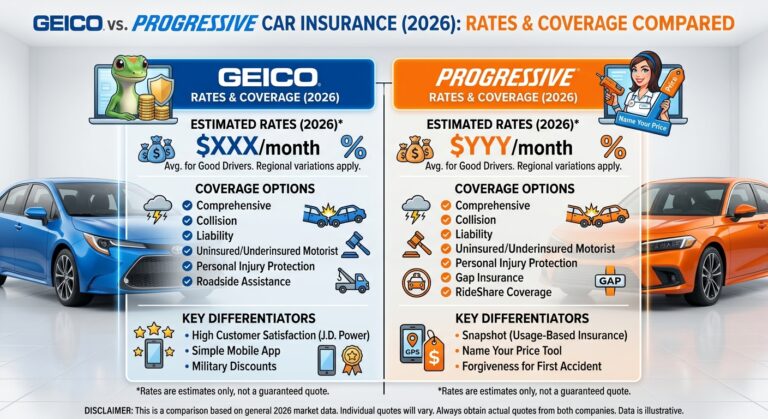
2. Geico: Best for Budget-Conscious Independent Drivers
Geico is renowned for offering some of the lowest baseline liability rates nationwide. For young adults setting up their very first independent auto insurance account without parent co-signers, Geico provides an accessible entry point. Their digital portal allows tech-savvy drivers to quickly customize policy limits to match exact monthly budgets, while their streamlined claim management system simplifies crash reports via smartphone uploads.
3. Progressive: Best for High-Risk Young Drivers & Telematics
Progressive stands out for its custom pricing software and proprietary Snapshot® telematics infrastructure. If a young driver has a minor speeding ticket or parking lot collision on their driving record, Progressive’s underwriting algorithms are often far more forgiving than those of traditional insurers. By opting into the Snapshot program, young drivers who avoid late-night driving and sudden hard braking can earn substantial personalized policy rewards.
4. Allstate: Best for Usage-Based Customization
Allstate caters exceptionally well to young adults who commute infrequently or attend local urban universities where driving is limited. Through Drivewise® and its pay-per-mile platform Milewise®, students who log low annual mileage can avoid paying flat-rate monthly premiums, paying instead based strictly on the exact distance driven.
5. Nationwide: Best for Vanishing Deductibles & Vanishing Rates
Nationwide offers excellent long-term incentives for young drivers committed to building a clean driving record. Through their SmartRide® telematics program, drivers receive an instant discount just for signing up, with potential earned discounts reaching up to 40% for exemplary driving behavior over a multi-month testing window.
Average Rate Comparison: Independent vs. Family Household Policies
One of the single most influential decisions a young driver can make is deciding whether to buy an independent single-driver policy or remain listed as an additional driver on their parents’ established multi-vehicle policy.
Joining a parent’s policy leverages the family’s established credit rating, multi-policy bundling discounts, and multi-vehicle pricing incentives, typically cutting the young driver’s insurance costs by 50% to 60% compared to an independent plan.
The following comparative table illustrates average annual rate expectations across major national insurers for drivers aged 16 to 24:
| Insurance Provider | Avg. Annual Cost (Added to Parent Policy) | Avg. Annual Cost (Independent Policy: Age 18-21) | Key Student Discount Features |
| State Farm | $1,850 / year | $3,400 / year | Steer Clear®, Good Student (up to 25% off) |
| Geico | $1,920 / year | $3,250 / year | Good Student, Distant Student Discount |
| Progressive | $2,100 / year | $3,650 / year | Snapshot® Telematics, Teen Driver Discounts |
| Allstate | $2,250 / year | $4,100 / year | Drivewise®, Smart Student Rewards |
| Nationwide | $2,050 / year | $3,800 / year | SmartRide®, Good Student Incentives |
Note: Figures represent national average estimates for full coverage policy structures. Actual individual rates vary according to state regulations, exact ZIP codes, vehicle age, and personal credit metrics.
Strategic Action Plan: How Young Drivers Can Slash Rates
Securing affordable auto insurance requires an active, multi-step strategy. Young motorists can implement several practical measures to systematically reduce their monthly bills without sacrificing critical liability protection.
1. Maximize Academic Performance Incentives
Insurance companies view academic discipline as a strong proxy for behavioral responsibility behind the wheel. Submitting a recent report card or official college transcript proving a 3.0 GPA (B average) or inclusion on the Dean’s Honor List can instantly trigger a 10% to 25% discount that stays active throughout the entire academic term.
2. Embrace Mobile Telematics Programs
Most modern insurance providers offer mobile app tracking that measures actual driving habits—including acceleration speed, cornering force, cellular phone distraction, braking intensity, and hours of operation. Young drivers who avoid driving between midnight and 4:00 AM (statistically the most dangerous driving hours) can earn substantial policy credits.
3. Select the Right Vehicle Make and Model
The physical car a young driver operates heavily influences their baseline collision and comprehensive premium tiers. Assigning a young driver to a high-horsepower sports car, a luxury sedan, or a brand-new electric vehicle with complex battery repair costs creates a severe spike in insurance pricing. Conversely, selecting a safe, moderately powered midsize sedan or compact crossover equipped with advanced safety tech (lane-departure warnings, automatic emergency braking, anti-lock brakes) keeps physical repair risks low.
4. Optimize Deductible Thresholds Responsibly
If a young driver maintains an accessible emergency cash reserve, adjusting policy deductibles from $250 or $500 up to $1,000 reduces the insurer’s liability risk, yielding an immediate drop in regular monthly bills.
Real-World Case Studies: How Young Drivers Saved Big
Case Study A: The College Student Strategy
- Driver Profile: Sophia, a 19-year-old sophomore attending university 150 miles away from home without a personal vehicle on campus.
- Initial Situation: Sophia’s family was paying full policy additions for her as an active primary driver on their household SUV, totaling $2,400 annually for her portion of the bill.
- Actions Taken:
- Sophia submitted her college transcript showing a 3.4 GPA, unlocking a 20% Good Student Discount.
- Her family updated her status to «Student Away at School,» reflecting that she only drove the family vehicle during winter and summer breaks.
- Financial Result: Her annual insurance cost dropped from $2,400 down to $980—a total annual savings of $1,420.
Case Study B: The Independent Young Professional
- Driver Profile: Marcus, a 22-year-old recent graduate setting up his first independent policy in a new city for a 2018 compact sedan.
- Initial Quote: Standard independent quotes from major carriers averaged $3,500 per year for full coverage.
- Actions Taken:
- Selected a carrier offering telematics tracking and maintained a clean 90-day driving score.
- Increased his collision deductible from $500 to $1,000 after setting aside a dedicated $1,000 emergency savings cushion.
- Bundled his auto insurance policy with his digital renters insurance plan.
- Financial Result: Marcus reduced his annual independent insurance premium down to $2,150—saving $1,350 per year.
Frequently Asked Questions (FAQs)
Is it legally required for a college student to get their own auto insurance?
No. If a student’s primary legal residence remains their parents’ house while attending college, they can usually remain listed on the family policy. However, if the student moves permanently to a new state, registers the vehicle in their own name, or purchases their own home, they must transition to an independent auto insurance policy registered to their new local address.
How much do car insurance rates drop when a driver turns 25?
While turning 25 is famously known as the threshold for major rate drops, the decrease is not an automatic magic switch. On average, drivers with a clean record see an automatic 15% to 25% price reduction around their 25th birthday, provided they have avoided at-fault accidents and moving violations in the preceding years.
What happens if a young driver gets a speeding ticket?
A single minor speeding ticket can cause a young driver’s insurance premium to rise by 20% to 35% at policy renewal. To mitigate this increase, many state jurisdictions allow young drivers to complete an approved defensive driving or traffic safety course to keep the violation points off their public driving record.
Final Thoughts & Consumer Resources
Navigating auto insurance as a young driver does not have to mean accepting overdrawn bank accounts or substandard coverage limits. By combining family household policy structures, maintaining strong academic records, leveraging modern mobile telematics software, and selecting safe, sensible vehicles, young motorists can build an exceptionally strong driving record while paying fair, manageable premiums.
For official state-by-state auto insurance consumer guidelines, complaint indexes, and regulatory resources, explore the educational tools hosted by the National Association of Insurance Commissioners (NAIC).