What Is a Car Insurance Deductible? An Easy Explanation
Navigating the world of auto policies can often feel like learning a completely foreign language. With terms like premiums, liability, limits, and exclusions thrown around, it is incredibly easy for new website owners and drivers to get confused. Among all these industry terms, one of the most critical concepts you must master is the deductible.
So, what is a car insurance deductible? In the simplest terms, a deductible is the specific amount of money you agree to pay out of pocket before your insurance provider steps in to pay for the remaining repair costs after an accident. Understanding how this financial mechanism operates will help you choose the right policy structure and avoid major financial surprises when filing a claim.
How a Deductible Works in a Real Claim Scenario
To truly grasp how a deductible functions, it is best to look at a practical, real-world example. The deductible amount is chosen by you when you first purchase or renew your auto policy. Standard options usually range from $250, $500, up to $1,000 or more.
Imagine you are driving and accidentally back into a concrete post, causing severe rear-end damage to your vehicle. You take the car to a certified repair shop, and the mechanic gives you an official estimate of $2,500 to completely fix the damage. If your policy has a chosen deductible of $500, the financial breakdown goes like this:
- You will pay your $500 deductible directly to the repair shop to jumpstart the mechanical work.
- Your insurance company will then issue a payment for the remaining $2,000 to cover the rest of the bill.
If the total repair bill is lower than your deductible—for example, a small scratch that costs $300 to fix—you do not file a claim, as the entire cost falls below your personal financial threshold.
The Direct Relationship Between Deductibles and Premiums
One of the most important aspects of choosing your policy limits is understanding that your deductible shares an inverse relationship with your monthly premium (your regular insurance bill).
If you choose a high deductible (such as $1,000), you are agreeing to take on more financial responsibility if an accident occurs. Because you are lowering the immediate financial risk for the insurance company, they will reward you by dropping your regular monthly premium payments significantly. Conversely, choosing a low deductible (like $250) means the insurer takes on almost all the risk, which causes your monthly premium bills to go up.
Which Types of Coverage Require a Deductible?
A common point of confusion for many policyholders is assuming that a deductible applies to every single aspect of an auto policy. In reality, deductibles are typically tied only to coverages that pay for physical damage to your own vehicle.
Collision and Comprehensive Claims
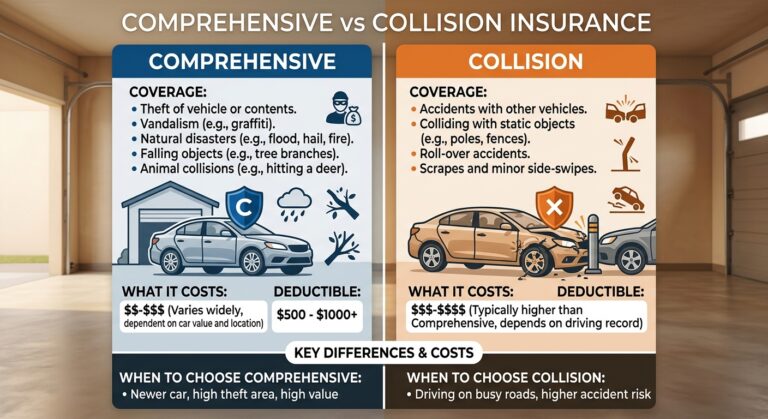
You will almost always have to pay your selected deductible when filing claims under collision coverage (hitting another vehicle or object) or comprehensive coverage (theft, vandalism, animal strikes, or storm damage).
Liability Claims Exemption
Deductibles do not apply to basic liability insurance. If you cause an accident that damages someone else’s car or injures another driver, your liability insurance pays for their losses from dollar one, up to your policy limits, without requiring you to pay a deductible fee.
Choosing the Best Deductible for Your Budget
Picking the right deductible amount requires a careful evaluation of your current savings and your regular monthly cash flow.
If you have a solid emergency fund saved up in the bank, choosing a higher deductible is a fantastic way to secure lower monthly car insurance payments over the course of the year. However, if living paycheck to paycheck makes it difficult to come up with $1,000 on short notice after a sudden crash, paying a slightly higher monthly premium for a lower deductible might provide better peace of mind.
For official regulatory insights, standard auto insurance definitions, and consumer protection worksheets, you can check out the public educational materials hosted by the National Association of Insurance Commissioners (NAIC).